Retiring in Nebraska: How the State Taxes Retirement Income, Homes and Inheritances
Retiring in Nebraska brings tax considerations beyond the federal income tax return. Nebraska excludes Social Security benefits from state income tax, offers property-tax relief to qualifying homeowners, and imposes an inheritance tax based on who receives the property.
These rules use different definitions of income. Income excluded from Nebraska income tax may still count for property-tax relief or Medicare premiums. The following summary explains the main rules and how they can interact.
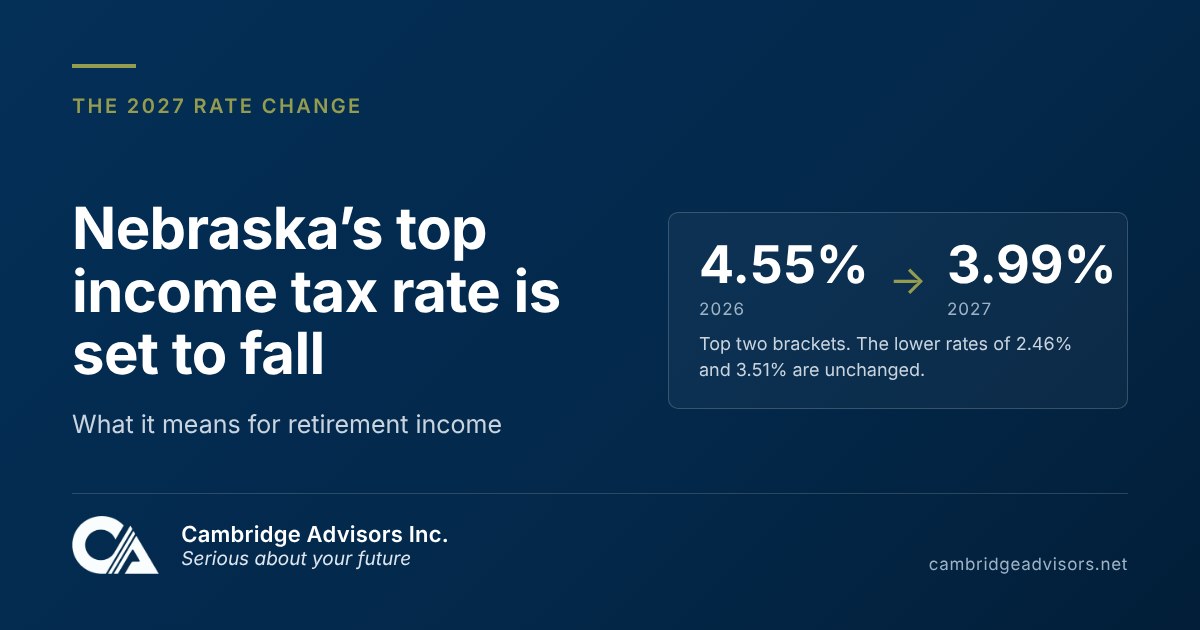
Nebraska’s Top Income Tax Rate Is Set to Fall to 3.99% in 2027: What It Means for Retirement Income
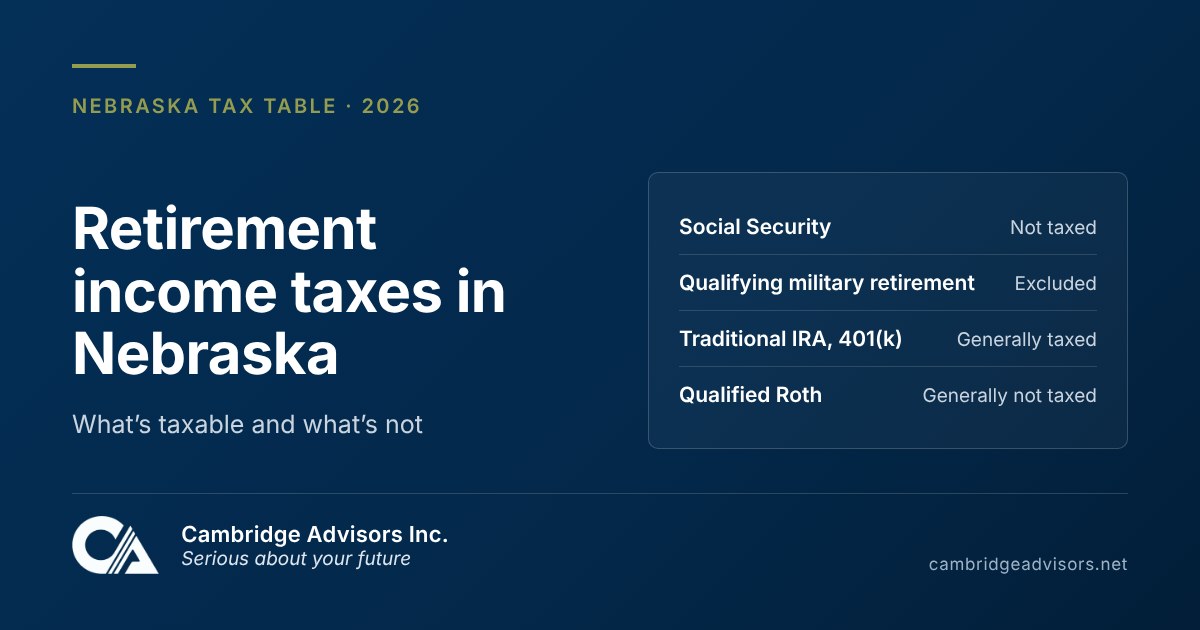
Nebraska Retirement Income Taxes in 2026: What’s Taxable and What’s Not
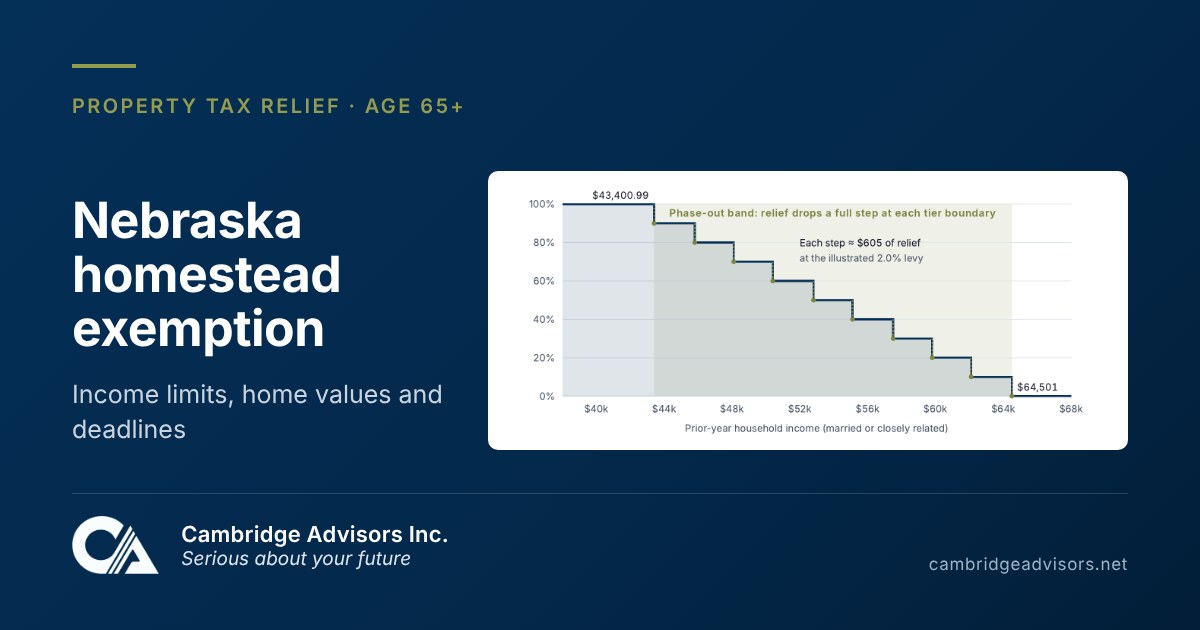
Nebraska Homestead Exemption for Homeowners 65 and Older: Income Limits, Home Values and Deadlines
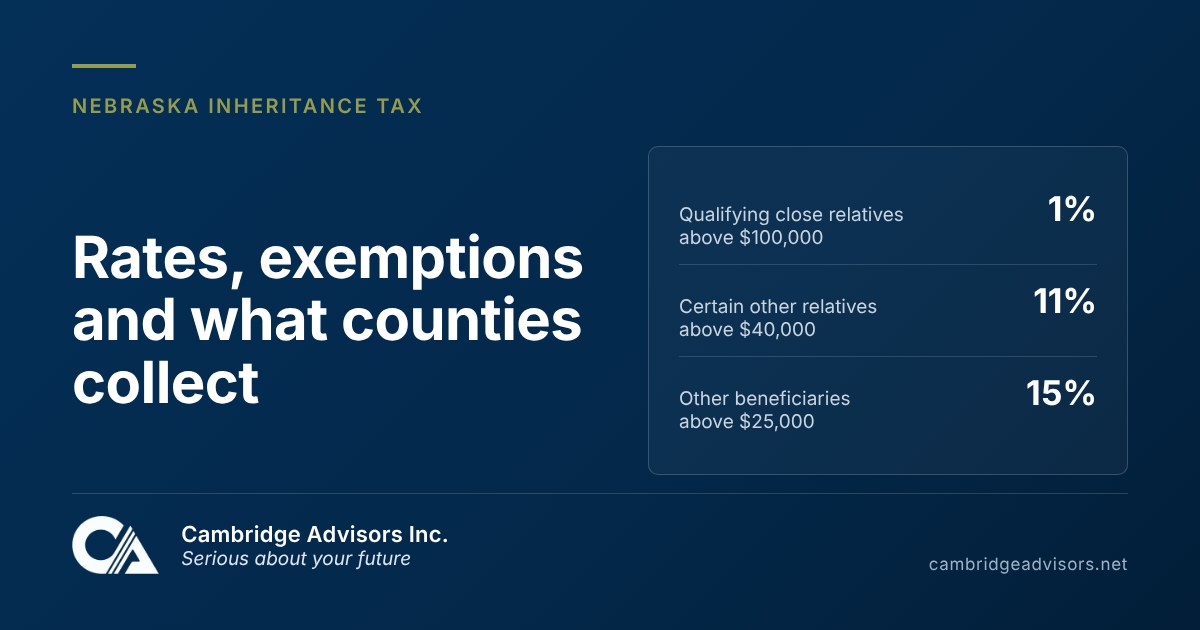
Nebraska Inheritance Tax: Rates, Exemptions and What Counties Collect
Nebraska Taxes and Retirement Income
Nebraska at a glance
| Tax or benefit | Nebraska treatment |
|---|---|
| Individual income tax | Top rate: 4.55% in 2026; scheduled to fall to 3.99% in 2027. |
| Social Security | Excluded from Nebraska income tax since tax year 2024. |
| Military retirement and CSRS | Qualifying amounts excluded to the extent included in federal adjusted gross income (AGI). |
| Traditional IRAs, 401(k)s and private pensions | Generally taxable to the extent included in federal AGI. |
| Qualified Roth IRA withdrawals | Generally excluded from federal and Nebraska income tax. |
| Homestead exemption, age-65 category | Income-based relief on an eligible exemption amount, subject to ownership, occupancy, value and filing rules. |
| Inheritance tax | Spouses and beneficiaries under 22 are exempt. Other rates and exemptions depend on the statutory relationship. |
Rules checked October 29, 2026.
How Nebraska taxes retirement income
Does Nebraska tax Social Security benefits?
No. Since tax year 2024, Nebraska allows a subtraction for 100% of Social Security benefits included in federal AGI. Federal rules may still include up to 85% of benefits in taxable income, depending on the household’s income. That is the taxable share of the benefit, not an 85% tax rate.
Does Nebraska tax IRA and 401(k) withdrawals?
Generally, yes. The taxable portion of traditional IRA, 401(k) and similar plan distributions is generally included in Nebraska income. After-tax basis and qualifying exclusions can change the result.
Qualified Roth IRA withdrawals generally are not taxable. Qualification requires the applicable five-tax-year period and a qualifying condition, such as reaching age 59½. Nonqualified withdrawals can have different tax consequences.
What about pensions?
Private pensions and Federal Employees Retirement System (FERS) annuities are generally taxable to the extent included in federal AGI. Nebraska excludes qualifying military retirement benefits and Civil Service Retirement System (CSRS) annuities. The CSRS exclusion began in tax year 2024; the full military retirement exclusion began in 2022.
A FERS annuity may include an eligible uniformed-service portion. Claiming that exclusion requires calculating and documenting the qualifying amount; it does not make the entire FERS annuity exempt.
What changes in 2027?
Under current law, Nebraska’s third and fourth individual income-tax rates fall from 4.55% in 2026 to 3.99% in 2027. The lower rates of 2.46% and 3.51% remain unchanged. Nebraska continues to use graduated rates; 3.99% is not a flat rate on all income.
The state-rate change is one factor when timing a withdrawal or Roth conversion. Federal taxes, future required withdrawals, homestead relief and Medicare premiums may have a larger effect on the decision.
Who qualifies for the homestead exemption?
Nebraska provides property-tax relief for qualifying homeowners age 65 or older, certain individuals with disabilities, and eligible veterans. This section describes the age-65 category; other categories have different requirements.
Applicants in the age-65 category generally must be 65 before January 1 of the application year, own and occupy the homestead from January 1 through August 15, meet household-income and applicable property-value requirements, and file Form 458 and Schedule I with the county assessor. Statutory exceptions may apply.
Income used for 2026 applications
| Age-65 category | Single | Married or closely related |
|---|---|---|
| 100% income-based percentage | Up to $37,000.99 | Up to $43,400.99 |
| No income-based relief | $54,301 or more | $64,501 or more |
These are 2026 application-year thresholds based on 2025 household income. The Department of Revenue marks the table subject to change. Between these limits, relief falls in 10-percentage-point steps. Use the table for the actual application year; these figures do not establish 2027 eligibility.
Household income starts with federal AGI and adds specified amounts, including Social Security retirement benefits not already included and Nebraska municipal bond interest. Qualifying unreimbursed medical expenses above 4% of household income before the medical deduction can reduce the amount used for the test.
A 100% income-based percentage does not necessarily eliminate the entire tax bill. County-specific rules limit the eligible exempt value and may reduce relief for higher-value homes. Certain prior recipients have statutory property-value protection; that protection does not remove the income test.
When should homeowners apply?
For the age-65 category, file annually after February 1 and on or before June 30. As of October 29, the regular 2026 deadline and possible county-board extension through July 20 have passed. Limited late-filing exceptions may apply for qualifying medical circumstances, a spouse’s death during the application year, or delayed qualifying VA certification.
Certain veteran categories have different repeat-filing rules under current law. Ask the county assessor about the applicable category, deadlines and documentation.
Does Nebraska have an inheritance tax?
Yes. Nebraska’s inheritance tax depends on the beneficiary’s statutory relationship to the deceased and the taxable value received. The following rates and exemptions apply to deaths on or after January 1, 2023.
| Beneficiary | Exempt amount | Rate on excess |
|---|---|---|
| Surviving spouse | Fully exempt | 0% |
| Children, grandchildren, parents, siblings and other qualifying immediate relatives | $100,000 per beneficiary | 1% |
| Aunts, uncles, nieces, nephews and certain other qualifying relatives | $40,000 per beneficiary | 11% |
| Other taxable beneficiaries | $25,000 per beneficiary | 15% |
| Beneficiaries under age 22 | Fully exempt | 0% |
These labels summarize detailed statutory definitions. Legal adoption, certain spouses and surviving spouses, and an acknowledged parental relationship can affect classification. Other exemptions may also apply. An attorney should confirm the treatment of each beneficiary and asset.
How does the exemption work?
Suppose an adult child age 22 or older receives a $150,000 taxable beneficial interest from a Nebraska resident and qualifies for the $100,000 immediate-relative exemption. The amount above the exemption is $50,000. At 1%, Nebraska inheritance tax would be $500.
Illustration only: ($150,000 - $100,000) x 1% = $500. The example assumes the stated amount is the taxable value before the beneficiary exemption and ignores other adjustments or exclusions. It does not represent an actual client.
Nebraska inheritance tax is administered at the county level and is separate from federal estate tax and any income tax on inherited retirement-account withdrawals. Probate avoidance alone does not determine whether inheritance tax applies.
How one retirement decision affects another tax
The long-form guide explains five different income measures: federal AGI, Nebraska taxable income, income used to determine Social Security taxation, Medicare income, and homestead household income. One transaction can affect several measures in different years.
Social Security is one example
Nebraska excludes the federally taxable portion from state income tax, while the homestead calculation includes Social Security retirement benefits, including the portion excluded from federal AGI. A state income-tax exclusion therefore does not establish eligibility for property-tax relief.
A Roth conversion can affect three different years
| A taxable conversion in 2026 may affect | When |
|---|---|
| Federal and Nebraska income tax | 2026 tax year |
| Homestead exemption | 2027 application, using 2026 household income |
| Medicare Part B and Part D income-related premiums | Generally 2028, using the usual two-year lookback |
Medicare generally uses federal AGI plus tax-exempt interest. Whether premiums increase depends on the applicable year’s thresholds and household circumstances. A conversion does not automatically cause a surcharge or loss of homestead relief.
Conversions create current tax costs and may reduce benefits. Their possible future value depends on future tax rates, spending, investment results and distribution needs. Compare the combined costs across years before choosing a conversion amount.
Read the long-form planning guide
Retirement Income Planning in Nebraska explains withdrawal sources, conversion timing, Social Security, Medicare and inheritance planning with worksheets and hypothetical households. Related hub topics cover the scheduled 2027 rate change, retirement-income taxes, the homestead exemption and inheritance tax.
Planning for retirement in Nebraska
Cambridge Advisors considers tax-related factors when coordinating retirement-income and investment decisions. Work with your tax professional and attorney on specific tax calculations and legal advice.
Contact Cambridge Advisors to discuss your retirement-income plan.
Important disclosures
Cambridge Advisors Inc. is a fee-only investment adviser registered with the U.S. Securities and Exchange Commission and based in Omaha, Nebraska. SEC registration does not imply any particular level of skill or training.
This article provides general educational information. It is not personalized investment, tax, accounting or legal advice and does not recommend a particular investment or tax strategy. Cambridge Advisors provides financial planning and investment advisory services but does not provide tax or legal advice.
Tax laws and interpretations can change. Results depend on personal circumstances, account types, available deductions and exemptions, and the rules for the applicable year. The inheritance-tax example is hypothetical. Investment and retirement-income decisions involve market risk, including possible loss of principal, and may have tax or liquidity consequences.
Consult a qualified tax or legal professional about your circumstances. Information about Cambridge Advisors’ advisory services, fees and conflicts is available in its Form ADV and Form CRS through the SEC Investment Adviser Public Disclosure website.
Primary sources and further reading
Source titles below link to official material.
Nebraska income-tax rates and retirement-income adjustments
Nebraska individual income tax rates | Nebraska income-tax adjustments
Nebraska DOR: military retirement and qualifying FERS portions
Military Retirement Benefits Exclusion
Nebraska homestead income table, guide, household-income definition, Schedule I, filing and value-protection statutes
2026 Household Income Table | Homestead Exemption Information Guide | Household income, defined | 2026 Form 458 Schedule I | Homestead application deadlines | Prior-recipient property-value protection
Nebraska inheritance-tax statutes: rates and beneficiary exemptions
Inheritance tax: immediate relatives | Inheritance tax: other relatives | Inheritance tax: other transfers
IRS Publications 915 and 590-B: Social Security and IRA distributions
Publication 915 | Publication 590-B
Social Security Administration: Medicare income-related premiums
Medicare premiums: higher-income beneficiaries